


StormWaters Plumbing

Boiler installation and replacement in northern Utah

Boiler installation means replacing or adding the boiler that heats water for your radiators, baseboards, or radiant floors. We size it to the home's heat loss, pipe it, vent it, and set it up for your elevation. We install conventional, condensing, and combi boilers across northern Utah. Estimates are free.

  • Free estimate
  • Price before work
  • 1-year guarantee

What to expect

  • The price before any work starts

    A free estimate first. No surprise on the bill.

  • You know who is coming

    A text with your plumber's name before we arrive

  • We show up when we say

    If we are running late, you hear from us first

  • No upsell. No is fine.

    We fix what you called about. You decide anything else.

How do I know it is time for a new boiler?

Plan a replacement when the heart of the boiler is failing or when repairs no longer hold.

  • The heat exchanger leaks or is cracked. This is the core of the boiler. When it fails, a new boiler is usually the sensible fix.
  • Parts are no longer made. Every breakdown turns into a search.
  • It locks out again and again. Repeat failures in one winter point to a boiler that is worn out.
  • It is far too large for the house. An oversized boiler cycles on and off all day, wastes fuel, and wears itself out.
  • The house has changed. An addition, a finished basement, or new radiant floors change the heating load.

Replacing a boiler in the fall is a planned job. Replacing it after it fails in January is an emergency. If your boiler is showing these signs, get an estimate before the cold arrives.

Not sure it is the right fit? Call and describe your house.

What types of boilers can I choose from?

Homes here use three types of hot water boiler.

A conventional boiler has one heat exchanger and sends hot exhaust up a chimney or metal vent. It is simple and works with high water temperatures.

A condensing boiler pulls extra heat out of the exhaust until water condenses from it. It needs a condensate drain and its own vent. ENERGY STAR certified gas boilers have efficiency ratings of 90% or greater, and condensing models are how manufacturers reach that range.

A combi boiler heats the house and makes hot water for the taps. Navien, one manufacturer, describes it as a boiler that heats the building and also heats domestic hot water on demand. It saves space because it replaces the boiler and the water heater.

The table on this page compares them.

How do you size a new boiler?

We size it by the heat the house loses, not by the label on the old boiler.

A heat loss calculation goes room by room. It counts the windows, walls, insulation, and ceiling height, and it uses the winter design temperature for your area. The result is the heat the house needs on the coldest nights.

Three more things go into the choice:

  • What gives off the heat. Radiant floors run on cooler water than baseboards or cast iron radiators. Cooler water is where a condensing boiler is most efficient.
  • Elevation. Gas burners put out less heat at high elevation. The Park City weather station sits at about 6,900 feet, so we use the manufacturer's high-elevation ratings there.
  • Hot water. A combi boiler also has to be sized in gallons per minute for showers and taps.

A boiler that is too big short cycles. One that is too small falls behind in a cold snap.

Rather ask a person? Call and we will answer it.

What happens during a boiler installation?

The work follows the same order on every job.

  1. Estimate. We measure the house, inspect the piping, radiators or floors, vent, and gas line, and give you a free estimate.
  2. Permit. We check what your city or county requires.
  3. Removal. We drain the system and take out the old boiler.
  4. Boiler and piping. We set the new boiler and build the piping around it: circulators, air separator, expansion tank, and fill valve.
  5. Gas, vent, and drain. We connect the gas line, run the vent and air intake, and pipe the condensate drain.
  6. Controls. We connect the thermostats and zone controls to the boiler.
  7. Fill and purge. We flush out old sludge, fill the system, add antifreeze where the system needs it, and purge the air.
  8. Startup. We test combustion, set the boiler for your elevation, and run every zone.

How long does it take to replace a boiler?

It depends on how much changes around the boiler. Swapping a boiler for the same type in the same spot is the shortest job. We give you the expected schedule with the estimate.

The job takes longer when we:

  • change from a conventional boiler to a condensing or combi boiler, which needs a new vent and a condensate drain.
  • run a larger gas line.
  • rebuild old piping, add zones, or replace circulators and valves.
  • flush a system that is full of sludge.
  • move the boiler to a new location.
  • add an indirect water heater, radiant floors, or a snowmelt zone.

The house has no heat from the boiler while the old one is out. In cold weather we plan the work to keep that gap as short as we can, and we tell you ahead of time how long to expect.

Rather ask a person? Call and we will answer it.

What affects the cost of a boiler installation?

We give free estimates. These are the things that decide the cost.

  • Boiler type and size. Conventional, condensing, and combi boilers differ in equipment and labor.
  • Venting. Reusing a sound chimney costs less than running a new vent through a wall or roof.
  • Gas line. A larger burner may need a larger line.
  • Piping and parts near the boiler. Old circulators, valves, and expansion tanks are often replaced at the same time.
  • Zones and controls. More zones mean more valves, thermostats, and wiring.
  • Condition of the system. Sludge has to be flushed, and old antifreeze has to be replaced.
  • Removal. An old cast iron boiler is heavy and may have to come out in pieces.
  • Permit fees. Each city or county sets its own.

Rebates or tax credits may be available for high-efficiency boilers. We can point you to the current program. Financing is available.

Want a number for your house? Estimates are free.

Do I need a permit for a new boiler in Utah?

Ask your city or county building department before work starts. A boiler replacement touches the gas line, the vent, and the heating piping, and those are the things inspectors look at.

Utah's State Construction Code adopts the 2024 International Mechanical Code and the 2024 International Fuel Gas Code, with state and local amendments. Local building departments issue the permits and do the inspections, and each one sets its own fees.

Salt Lake City, for example, requires a permit before any installation or alteration to a building's plumbing or mechanical system.

Before work starts, ask us who applies for the permit and who meets the inspector. Keep the signed-off permit with your house records. A buyer's inspector or an insurance adjuster may ask for it later.

Conventional, condensing, and combi boilers compared
What to compareConventionalCondensingCombi
What it doesHeats the houseHeats the houseHeats the house and makes hot water for the taps
How it uses heatOne heat exchanger. Exhaust leaves hotPulls more heat from the exhaust until water condensesCondensing design with a second circuit for tap water
VentingChimney or metal ventIts own sealed vent, often through a side wallIts own sealed vent, often through a side wall
Condensate drainUsually not neededRequiredRequired
Where it fitsHigh-temperature radiators and baseboardsRadiant floors and other low-temperature systemsHomes short on space with modest hot water use
Hard water careKeep the closed loop tight so it takes on little fresh waterYearly service, clean heat exchanger and condensate trapSame as condensing, plus descaling the tap water side

What it costs

Why boiler quotes need eyes on the system

Two boiler replacements can be far apart in price because of the venting, the fuel, the number of zones, and whether the old piping can be reused. We look at the system, then give you a price. The estimate is free.

  • Boiler type and efficiency
  • Venting and gas supply
  • Number of zones and the condition of the piping
  • Glycol, controls, and sensors on a snowmelt system

Larger jobs can be paid over time through Wisetack.

See financing options

The visit

What happens when you call about a boiler

  1. 1

    Call or book

    Tell us what the boiler is doing. If it quit in freezing weather, call the emergency line. A person answers 24/7.

  2. 2

    You know who is coming

    You get a text with your plumber's name before we arrive. Drop cloths go down in the boiler room.

  3. 3

    Diagnosis and a price before any work

    We test the system, show you the failed part or the pressure problem, and give you the price.

  4. 4

    You decide. We fix it.

    We clean up when we are done, and the work is covered for 1 year.

4.9

from 56 Google reviews

As of October 2026

Read all 56 reviews on Google Maps

If it is not right, we come back

100% satisfaction guarantee for 1 year after service

How the guarantee works

Recent jobs

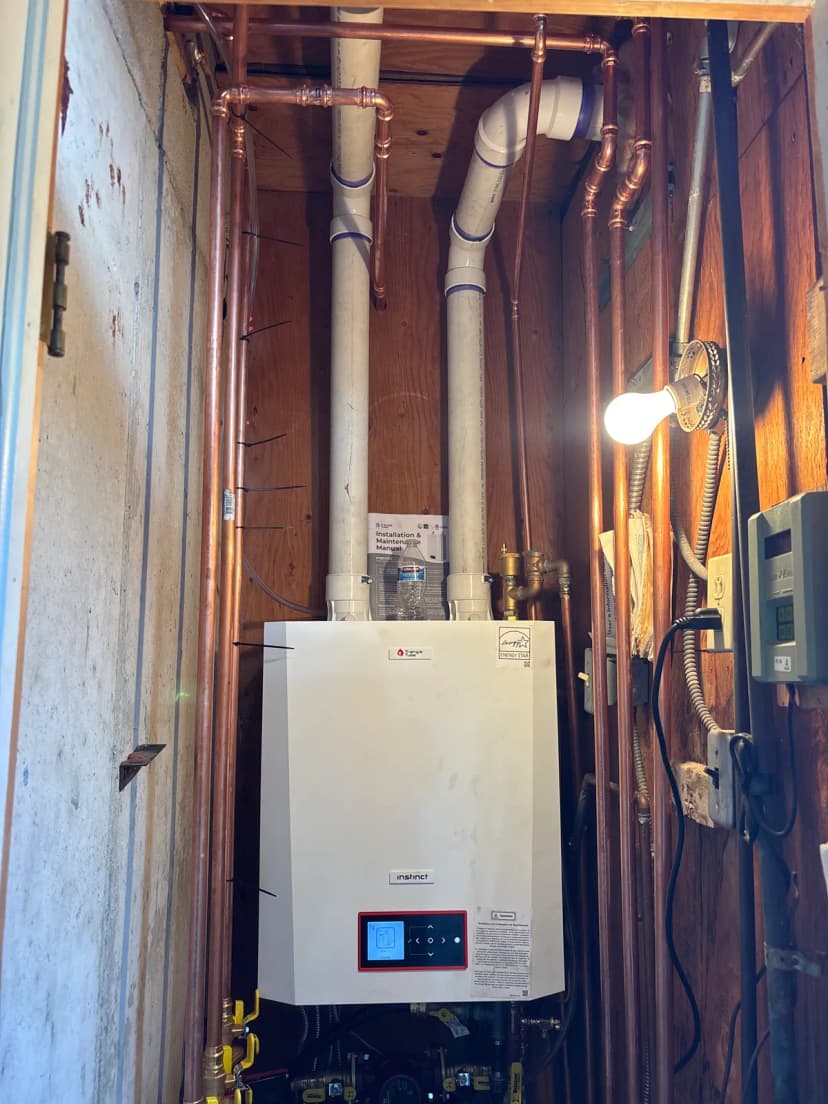
A white wall-hung boiler in a closet with two white PVC vent pipes above it and new copper piping on both sides.
Taylorsville, August 2025

Boiler Installation

TaylorsvilleAugust 2025

Problem
A home's boiler needed to be replaced with a high-efficiency one.
What we did
We took out the current boiler and installed a new 155,000 BTU high-efficiency condensing boiler that vents with PVC instead of metal venting, along with the pumps, piping, and electrical needed to update the system. We built a primary loop and a domestic hot water loop that gives the existing indirect water heater priority when it is in use. The upstairs and downstairs zones each got their own pump, and the thermostats are now powered by the boiler.

Boiler and radiant heat questions

Is yours not here? Call (385) 338-6068 and ask. We would rather answer it than have you guess.

What is the average lifespan of a boiler?

It varies too much for one honest number. A boiler in a clean, tight system that is serviced every year usually outlasts a water heater by a wide margin. What shortens its life is a system that leaks and keeps taking on fresh hard water, a boiler that is oversized and short cycles, and years without service. We can tell you where yours stands after an inspection.

What is a combi boiler, and is it a good idea with hard water?

A combi boiler heats the house and the tap water from one unit. Navien describes it as a boiler that also heats domestic hot water on demand. Tap water runs through it all day, so hard water scales the hot water side. Provo's 2025 water report gives typical hardness of 10–15 grains per gallon. Plan on regular descaling, a water softener, or both.

Can a new boiler use my existing radiators or radiant floors?

Usually, yes. We inspect the radiators, baseboards, or floor loops, pressure test the piping, and flush out sludge so it does not end up in the new heat exchanger. We also check the water temperature your system needs. Cast iron radiators and baseboards run hotter than radiant floors, and that affects which type of boiler makes sense.

Is a condensing boiler worth it?

It is when the system lets it condense. A condensing boiler gains its extra efficiency when the water coming back from the house is cool. Radiant floors return cool water, so they are a strong match. High-temperature baseboards return hotter water, and the gain is smaller. A condensing boiler also needs a condensate drain and yearly service. We check your system before we recommend one.

Boiler Installation across northern Utah

Based in Lehi, working in nine counties.

Related services

No heat? Tell us what the boiler is doing.

Call or text. A person answers the emergency line 24/7.

Office Mon to Fri, 7 am to 6 pm. Emergency line 24/7.