StormWaters Plumbing

Water heater replacement and installation in northern Utah

Water heater replacement means taking out the old heater and installing a new one that is sized, vented, and connected to current code. A tank-for-tank swap is usually done in one visit. You need it when the tank leaks, rusts, or cannot keep up. We replace water heaters across northern Utah. Estimates are free.

  • Free estimate
  • Price before work
  • 1-year guarantee

What to expect

  • The price before any work starts

    A free estimate first. No surprise on the bill.

  • You know who is coming

    A text with your plumber's name before we arrive

  • We show up when we say

    If we are running late, you hear from us first

  • No upsell. No is fine.

    We fix what you called about. You decide anything else.

How do I know it is time to replace my water heater?

Replace the heater when the tank itself is failing or when it no longer fits the household.

  • The tank leaks. Water from the tank body or its seams means the steel has corroded through. No repair fixes that.
  • The hot water is rusty. If a new anode rod does not clear it, the tank is rusting from the inside.
  • The heater is old. ENERGY STAR says to consider replacement once a water heater is more than 10 years old. The date of manufacture is often printed on the label with the serial number.
  • Repairs keep coming. A second or third repair on an older tank is money better put toward a new one.
  • You run out of hot water. A bigger family or a new bathroom can outgrow the heater.

Replacing on your schedule gives you time to compare types. Replacing after a leak does not.

Not sure it is the right fit? Call and describe your house.

What happens during a water heater replacement?

The job has two parts: the estimate visit and the install.

At the estimate we measure the space and check the gas line, vent, water lines, drain pan, and shut-off valves. You choose the heater, and we give you a free estimate.

On install day we:

  1. Shut off the water and fuel, then drain, remove, and haul away the old heater.
  2. Set the new heater and connect the water, gas or power, and vent.
  3. Add or replace the parts the installation calls for, such as the expansion tank, shut-off valve, drain pan, and earthquake straps.
  4. Fill the tank, start the heater, and check every joint for leaks.
  5. Set the temperature. The Consumer Product Safety Commission urges a setting of 120 degrees Fahrenheit to prevent scalds.
  6. Show you the shut-off valve and the maintenance schedule.

How long does a water heater replacement take?

A like-for-like tank replacement in the same spot is usually finished in a single visit. You are without hot water while we work, and a new tank needs time to heat its first full load after we fill it.

The job takes longer when we have to:

  • move the heater to a new location.
  • switch from a tank to a tankless heater.
  • run a larger gas line or a new vent.
  • correct older work that does not meet current code.
  • work in a tight closet, an attic, or a crawl space.

Where a permit is required, the inspection is a separate visit scheduled with the building department. We tell you the expected timeline at the estimate, before you commit to anything.

Rather ask a person? Call and we will answer it.

What affects the cost of a water heater replacement?

We give free estimates. These are the things that move the cost up or down.

  • Type of heater. Tank, tankless, and heat pump heaters differ in equipment and labor.
  • Size. A larger tank or a higher-output tankless heater costs more.
  • Fuel and venting. A heater that needs a new vent, a larger gas line, or a new electrical circuit takes more work.
  • Code updates. An older installation may need an expansion tank, earthquake straps, a drain pan, or new shut-off valves.
  • Location and access. Attics, closets, and crawl spaces add labor. Moving the heater adds more.
  • Permit fees. Each city or county sets its own.

Utility rebates or tax credits may be available for high-efficiency heaters. We can point you to the current program. Financing is available.

Want a number for your house? Estimates are free.

Should I choose a tank, tankless, or heat pump water heater?

It depends on your fuel, your space, and how your household uses hot water.

A tank heater is the simplest swap when you already have one. It stores hot water, so it can run out during heavy use.

A gas tankless heater heats water as it flows. ENERGY STAR notes that an installer has to confirm the gas line, the power supply, and the vent route before you commit. In hard water it needs regular descaling.

A heat pump heater is electric and moves heat from the surrounding air into the tank. ENERGY STAR says it belongs in a space that stays between 40 and 90 degrees Fahrenheit with 1,000 cubic feet of air around it, so an unheated garage that freezes in winter is a poor fit.

The table on this page compares the three side by side.

Do I need a permit to replace a water heater in Utah?

Your city or county building department decides, so ask before work starts.

Utah's State Construction Code adopts the 2024 International Plumbing Code and the 2024 International Fuel Gas Code, with state and local amendments. Local building departments issue the permits and do the inspections.

Salt Lake City, for example, requires a permit before any installation or alteration to a building's plumbing or mechanical system.

Before work starts, ask us who applies for the permit and who meets the inspector. The permit and inspection protect you. They put a second set of eyes on the gas connection, the vent, and the relief valve.

Utah's Division of Emergency Management also tells homeowners to have the water heater secured to wall studs with earthquake straps.

Rather ask a person? Call and we will answer it.

How do I make a new water heater last in hard water?

Keep the minerals from building up. Provo's 2025 water report gives typical hardness of 10–15 grains per gallon, and Salt Lake City's 2026 report lists 8.0 to 12.4 at its three treatment plants. Both are hard enough to leave sediment in a tank and scale in a tankless heater.

A maintenance visit covers four things:

  • Flushing. We drain the sediment from a tank or descale a tankless heat exchanger.
  • The anode rod. We check it and replace it before it is used up, so the rod corrodes and the tank does not.
  • The expansion tank and relief valve. We test both.
  • The temperature setting. Hotter water drops more scale.

A water softener ahead of the heater cuts scale at the source. With softened water the anode rod can wear faster, so it still needs to be checked.

Tank, tankless, and heat pump water heaters compared
What to compareTankGas tanklessHeat pump
How it heatsGas burner or electric elements heat stored waterGas burner heats water as it flows throughElectric heat pump moves heat from the air into stored water
Hot water supplyLimited to the tank, then a wait to reheatContinuous, limited by gallons per minuteLimited to the tank, then a wait to reheat
Space neededFloor space for the tankHangs on a wallFloor space plus open air around the unit
What the install may needLeast change when replacing a tankGas line and vent check, power outlet, condensate drain on condensing modelsElectrical circuit, condensate drain, a space that stays above 40 degrees Fahrenheit
Hard water careFlush sediment, check the anode rodDescale the heat exchanger, clean the inlet filterFlush sediment, check the anode rod, clean the air filter
Power outageA gas tank with a standing pilot keeps working. Power-vented models stopStops until power returnsStops until power returns

What it costs

Why we quote after we look, not over the phone

Two replacements of the same size tank can cost different amounts because of the venting, the gas line, code upgrades, and access. A price given over the phone is a guess. We look first, and the estimate is free.

  • Tank size and fuel type
  • Venting and gas line changes
  • Code upgrades the installation needs
  • Location and access

Larger jobs can be paid over time through Wisetack.

See financing options

The visit

What happens when you call about a water heater

  1. 1

    Call or book

    Tell us what you see. If there is water on the floor, we tell you which valve to close.

  2. 2

    You know who is coming

    You get a text with your plumber's name before we arrive. Shoe covers go on at the door.

  3. 3

    Diagnosis and a price before any work

    We test the heater, show you what failed, and give you the price of a repair and of a replacement.

  4. 4

    You decide. We do the work.

    We haul away the old heater, clean up, and the work is covered for 1 year.

4.9

from 56 Google reviews

As of October 2026

Read all 56 reviews on Google Maps

If it is not right, we come back

100% satisfaction guarantee for 1 year after service

How the guarantee works

Recent jobs

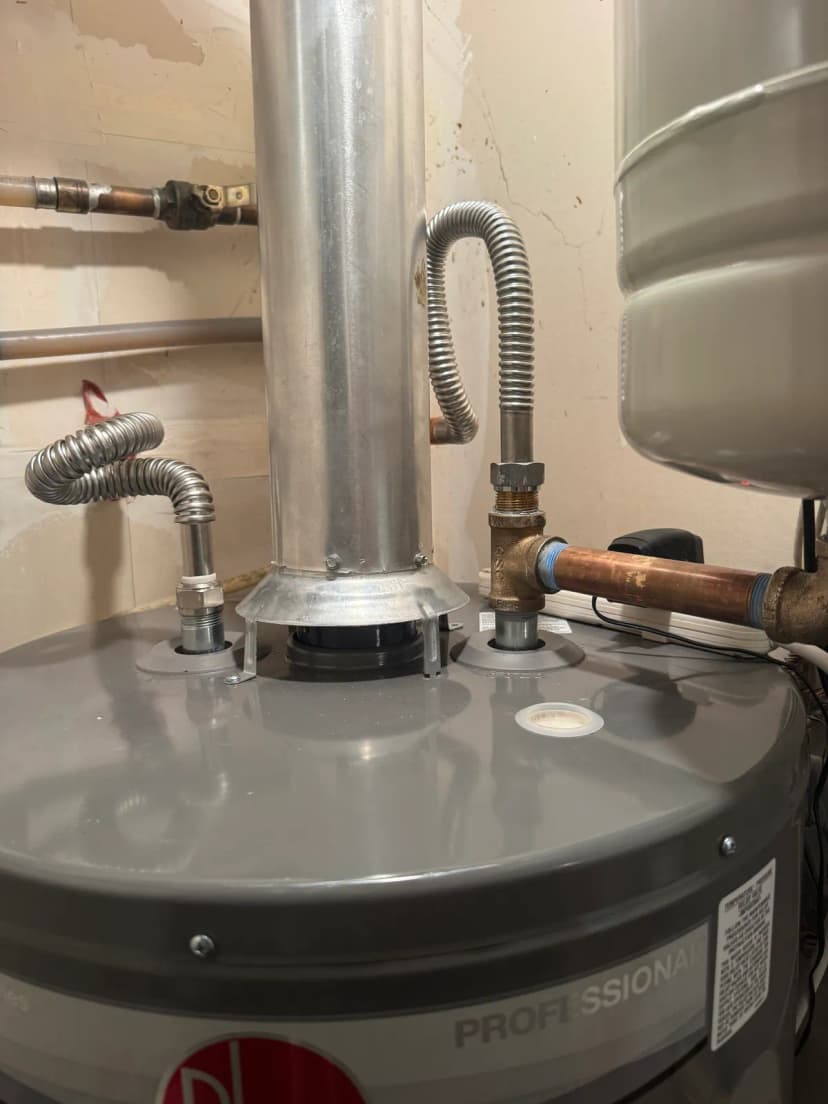
  • The top of a gray tank water heater with a metal vent pipe, two stainless flex lines, and an expansion tank beside it.
    Salt Lake City, August 2026

    Water Heater Replacement

    Salt Lake CityAugust 2026

    Problem
    An older water heater needed to be replaced.
    What we did
    We installed a 50-gallon Rheem tank water heater and hauled away the old unit. We brought it up to code with an expansion tank, a drip leg on the gas line, earthquake straps, and new flex lines.
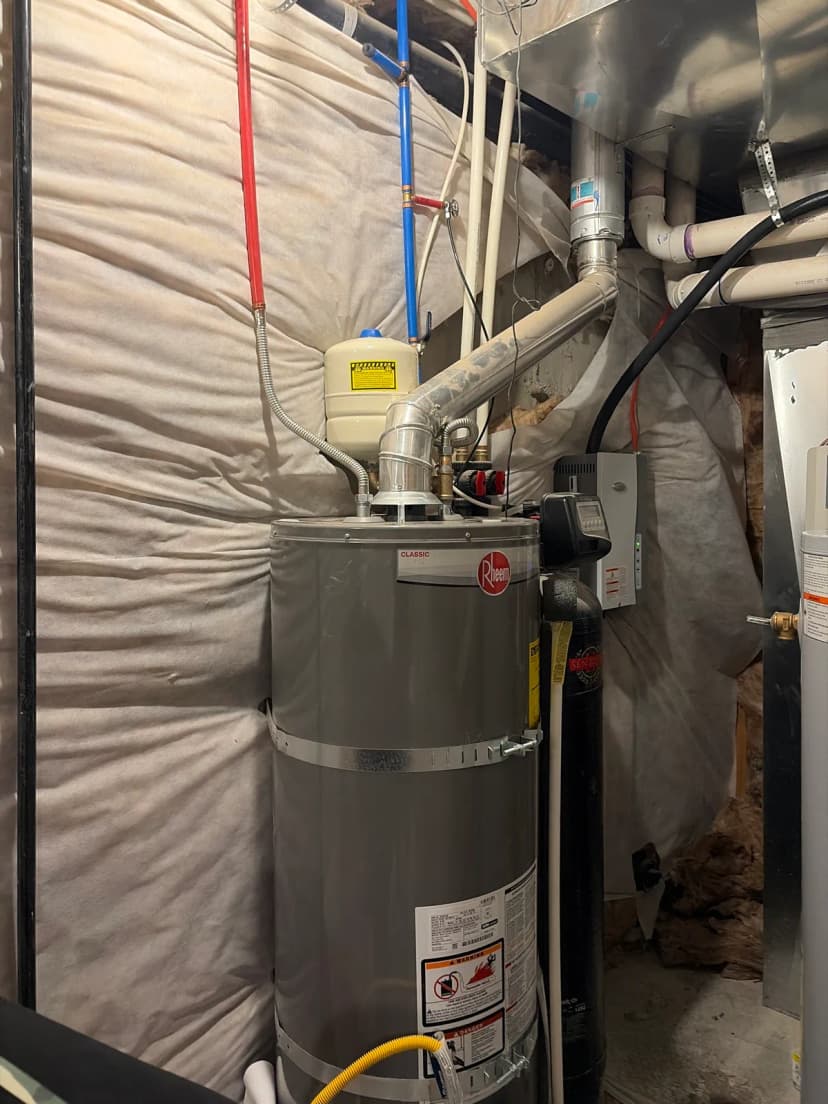
  • A gray water heater strapped to a wall, with an expansion tank, flexible water lines, and a metal vent pipe above it.
    Eagle Mountain, April 2026

    Water Heater Replacement

    Eagle MountainApril 2026

    Problem
    A 50-gallon water heater needed to be replaced.
    What we did
    We removed and disposed of the old A. O. Smith unit and installed the new water heater with a new expansion tank, new gas and water flex lines, and a drip leg added per code.
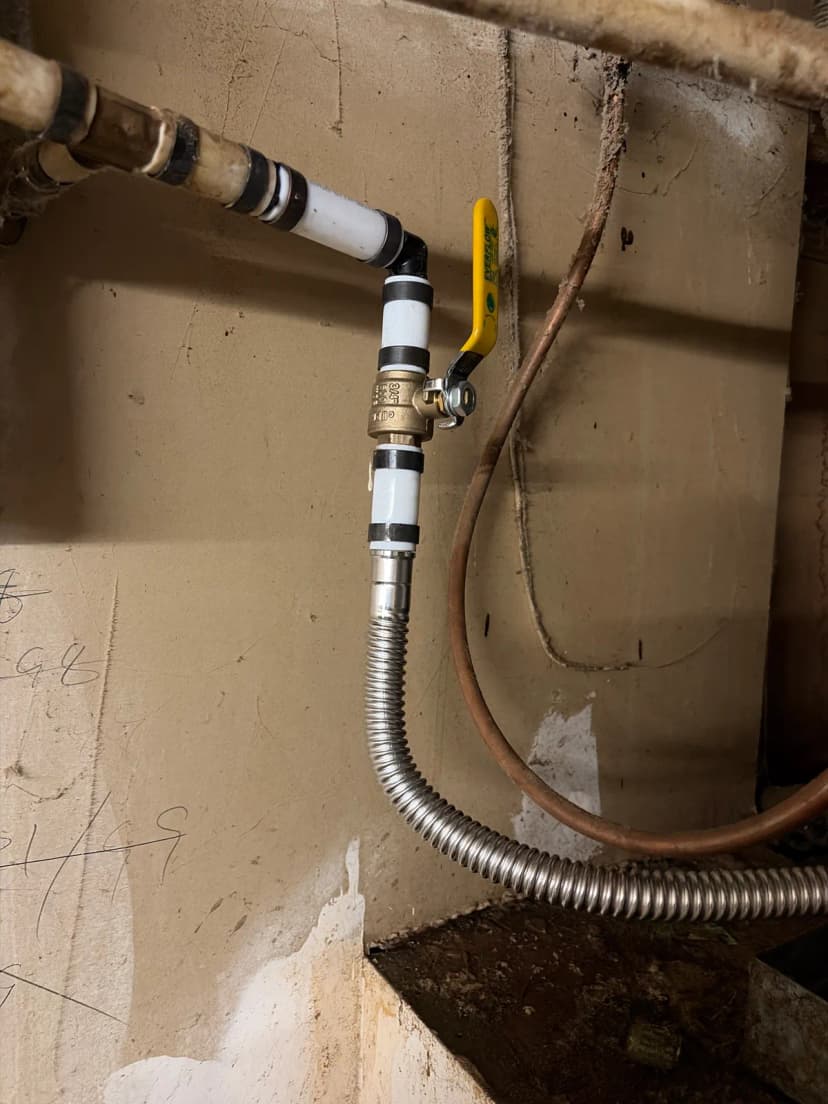
  • A brass ball valve with a yellow handle on white pipe, connected to a corrugated stainless steel water line.
    Taylorsville, March 2026

    Water Heater Replacement

    TaylorsvilleMarch 2026

    Problem
    The customer supplied a water heater to replace the older unit.
    What we did
    We drained down the unit, hauled away the older one, and installed the unit the customer supplied, bringing the rest of the parts needed. We cut in a new valve to isolate the unit, rebuilt that area of the water lines, and installed two new water supply lines.
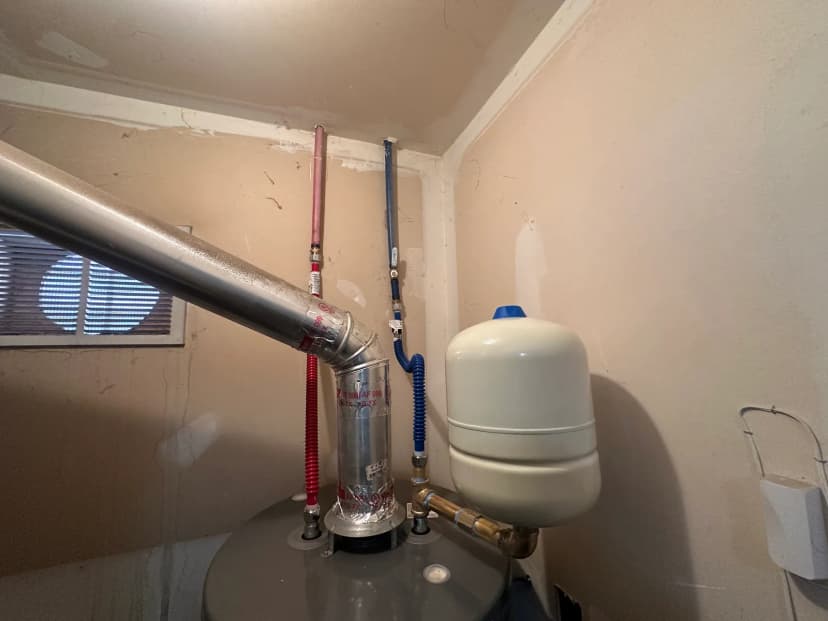
  • The top of a water heater with an expansion tank, flexible water lines, and a metal vent pipe.
    Lehi, November 2025

    Water Heater Replacement

    LehiNovember 2025

    Problem
    A water heater needed to be replaced.
    What we did
    We replaced it and brought the installation up to code with a sediment tee, an expansion tank, a ball valve, earthquake straps, and new water and gas flex lines.
  • Water Heater Replacement

    South JordanAugust 2026

    Problem
    The home needed a new 50-gallon water heater.
    What we did
    We installed a 50-gallon Rheem water heater with new water supply lines, a new gas flex line, and a new expansion tank, and hauled away the old unit.
  • Water Heater Replacement

    LaytonJuly 2026

    Problem
    The customer had a water heater to replace an older unit.
    What we did
    We installed it with a new expansion tank, a sediment tee at the unit, earthquake straps, a new 1/2-inch gas shut-off, and new water and gas supply lines. We hauled away the older unit.

Water heater questions

Is yours not here? Call (385) 338-6068 and ask. We would rather answer it than have you guess.

Do I need a plumber to replace a water heater?

Use one. A replacement means new water connections, a gas or electrical connection, a vent that drafts correctly, and a relief valve piped to a safe spot. A mistake on the gas line or the vent can put carbon monoxide in the house. A plumber also knows when your city or county requires a permit and an inspection.

What is the average lifespan of a water heater?

There is no single number, because water quality and maintenance change it so much. ENERGY STAR's rule of thumb is to consider replacement once the heater is more than 10 years old. Hard water, a used-up anode rod, and a tank that has never been flushed all shorten the life of a heater. The label on the tank shows when it was made.

What is the average cost to replace a water heater in Utah?

We do not quote an average, because two homes on the same street can need very different work. The cost depends on the type and size of the heater, the venting and gas line, code updates, access, and the permit fee in your city. We look at your installation and give you a free estimate. Financing is available.

Why do plumbers charge so much to replace a water heater?

The heater on the store shelf is only part of the job. A proper replacement also covers removing the old tank, new water and gas connectors, vent work, an expansion tank or earthquake straps where the installation needs them, the permit where one is required, and the time of a licensed plumber who is responsible for the gas and venting being safe.

What size water heater do I need?

If your current heater keeps up most of the time, ENERGY STAR says you can probably replace it with one the same size. Compare the first-hour rating too. It measures how much hot water the heater delivers in a busy hour. If you run out often, or you have added people or a bathroom, tell us and we will size the new heater for that.

Water Heater Replacement across northern Utah

Based in Lehi, working in nine counties.

Related services

No hot water? Tell us what you are seeing.

Call or text. A person answers 24/7, and you get a text with your plumber's name before we arrive.

Office Mon to Fri, 7 am to 6 pm. Emergency line 24/7.